
← Blog

AI for clinical trials

Chatbots vs. Decision Models: Choosing the Right AI for Clinical Trials

October 2026 · 6 min read

Written by Husain Amjherwala

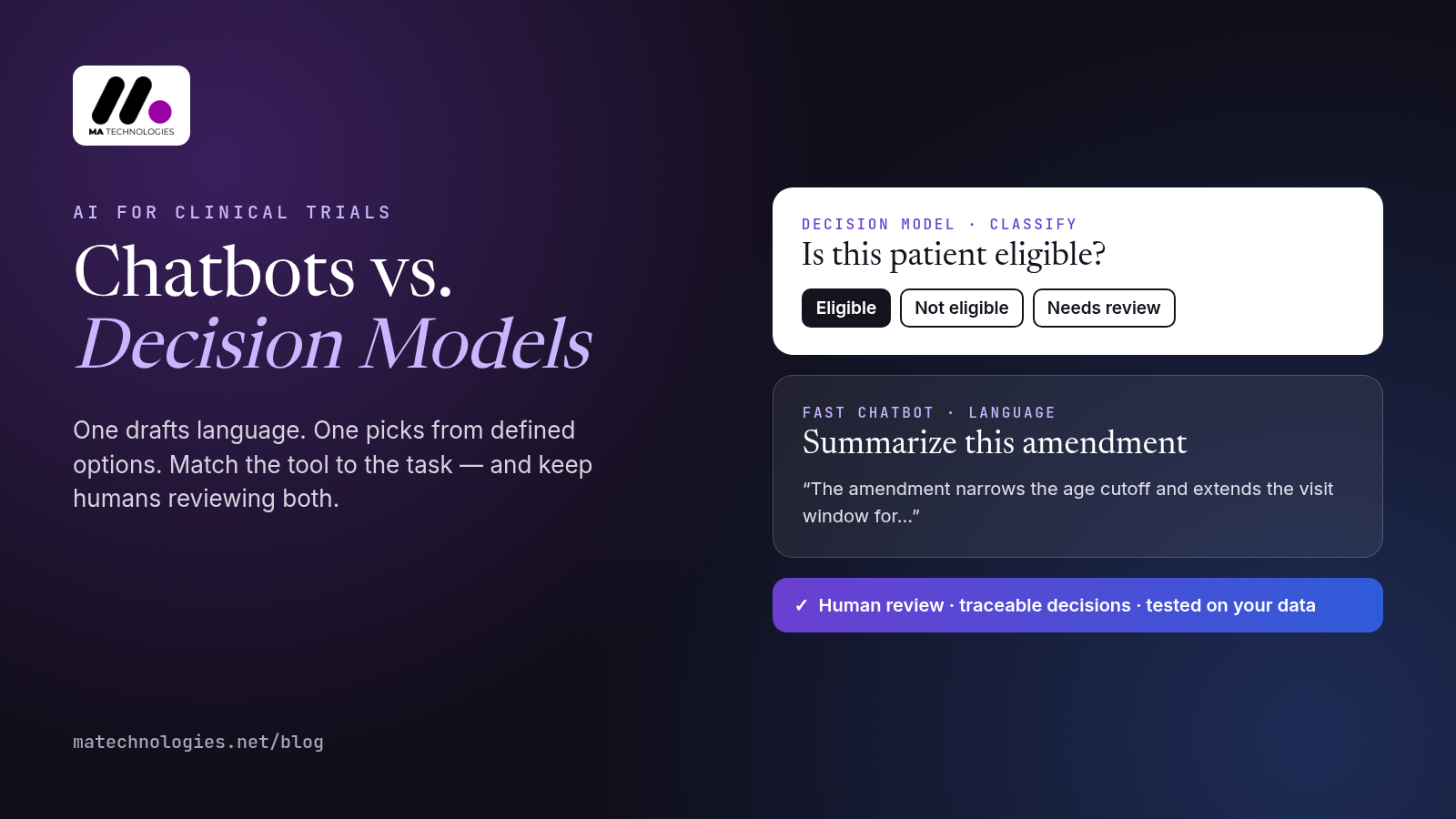
Chatbots vs. decision models: a classification choice next to a drafted summary, with human review

Ask people at a research site what AI looks like, and many will picture a chatbot. You type a question, and it gives you a paragraph in return. (Handy when an amendment needs decoding at the end of a long day.)

Spend a day alongside a study coordinator, though, and another side of the work comes into view. Much of it isn't writing. It's making small, repeated decisions. Is this referral worth a call? Does the patient meet the age cutoff? Did the visit happen within the allowed window? Does the dose in the EDC match the visit note?

These questions often have a limited set of possible answers, and they come up dozens of times a day. That's where decision models may help. To understand where they fit, it helps to compare them with the chatbots many teams already know.

Two approaches, two different jobs

Fast chatbots, such as Claude Haiku, DeepSeek Flash, or Gemini Flash, are useful when a task involves language. They can read, summarize, explain, and draft, generating a response in natural language.

A decision model takes a different approach. Rather than drafting a response, it selects from options defined in advance, such as “eligible,” “not eligible,” or “needs review.” It may also return a score or confidence estimate. Jev, released by TypeSafe AI in September 2026, is one example of this approach.

The distinction is about the kind of output each system produces, not a guarantee that one is more accurate or safer than the other. A structured answer can still be wrong.

ComparisonDecision model (e.g., Jev)Fast chatbot (e.g., Claude Haiku)
Typical outputA choice from predefined options, sometimes with a score or probabilityWritten text, or structured data when requested
Output formatDesigned to return one of the specified optionsCan occasionally return unusable output; about 1.4% of Haiku responses in one test
Accuracy in one reported comparisonAbout 66% (Jev)About 94% (Haiku)
SpeedAbout a third of a second per medical question in the reported testVaries with the length and complexity of the response
CostFractions of a cent per query, as reportedLow, but typically depends on input and output volume
Potential fitHigh-volume tasks with a defined set of choicesReading, summarizing, drafting, and tasks requiring nuance

These figures come from a specific comparison, not a universal ranking. Performance will depend on the task, the data, and how each system is evaluated.

Different strengths, one workflow

It's more useful to see these systems as tools for different jobs than as direct competitors. A decision model may be suited to an initial check against inclusion criteria, flagging diary entries that may mention an adverse event, or identifying a possible mismatch between an EDC dose and a visit note. A chatbot may be better suited to extracting details from a long report into a table, drafting an initial SAE narrative, or simplifying protocol language for review.

In either case, human oversight remains essential. A chatbot's draft needs review before it is used, and a decision model's flags need checking. That should include sampling cases it did not flag, too; otherwise, a system can appear to perform well while quietly missing important cases.

Early evidence

A polished answer can still be wrong

Early testing suggests decision models can return consistent, well-formatted answers that are incorrect. In a comparison, Sheraz Khan and colleagues tested five decision models against four fast chatbots, using 1,000 questions repeated 100 times. Jev was the most accurate of the decision models tested, but still answered about one in three questions incorrectly; Haiku answered about 94% correctly.

What stood out was how consistently some mistakes appeared. Jev returned the same incorrect answer on 162 questions across all 100 repetitions. Haiku did so on six. It's a little like a navigation app that sends you down the same wrong road every morning, with complete confidence.

~66%

Jev accuracy in the reported comparison

162

Questions Jev got wrong the same way, all 100 times

60% vs 82%

Complex diagnostic cases: Jev vs a leading chatbot

A separate medical study published in October reported a similar pattern. Jev performed comparably to a leading chatbot on research abstracts, but scored lower on complex diagnostic cases, at roughly 60% versus 82%. Its confidence scores were more useful on simpler questions than on harder ones.

That makes it risky to assume that uncertain cases can simply be routed to a person. Confidence scores should first be tested against the tasks and data where the model will be used. Neither study evaluated these systems in live research-site workflows, so the results should be treated as an early signal, not a prediction of site-level performance.

Read Sheraz Khan's write-up of the comparison: Decision models vs. flash LLMs.

The cost that matters most

For a research site, the cost of an AI query may be small compared with the consequences of an error. A misrouted inquiry might cost a few minutes. Missing an eligible patient could affect enrollment. Overlooking a potential adverse event carries a different level of risk.

That's why a sensible starting point is a high-volume, lower-risk task where mistakes can be detected and corrected. Before introducing either type of AI, teams should ask four questions:

  1. 01Is this mainly a classification task or a language task?
  2. 02What happens if the system is wrong?
  3. 03Has it been evaluated on our own data?
  4. 04Who reviews the output, with decisions recorded and traceable?

Build around the workflow, not the model

Used thoughtfully, the two approaches can complement each other: one can help sort and flag information, while the other helps people work with documents and language. The research team remains responsible for decisions that affect participants, data quality, and trial conduct.

At MA Technologies, we help research sites, site networks, and CROs assess where different AI approaches may fit, test them against their own data before they are relied on, and integrate them with existing CRM and CTMS platforms. The aim is not to automate every decision. It's to make useful workflows more reliable, while keeping people involved where judgment matters.

Where would you use a decision model, and where would you keep a language model in the mix?

Match the AI to the task, test it on your own data, and keep people involved where judgment matters.