
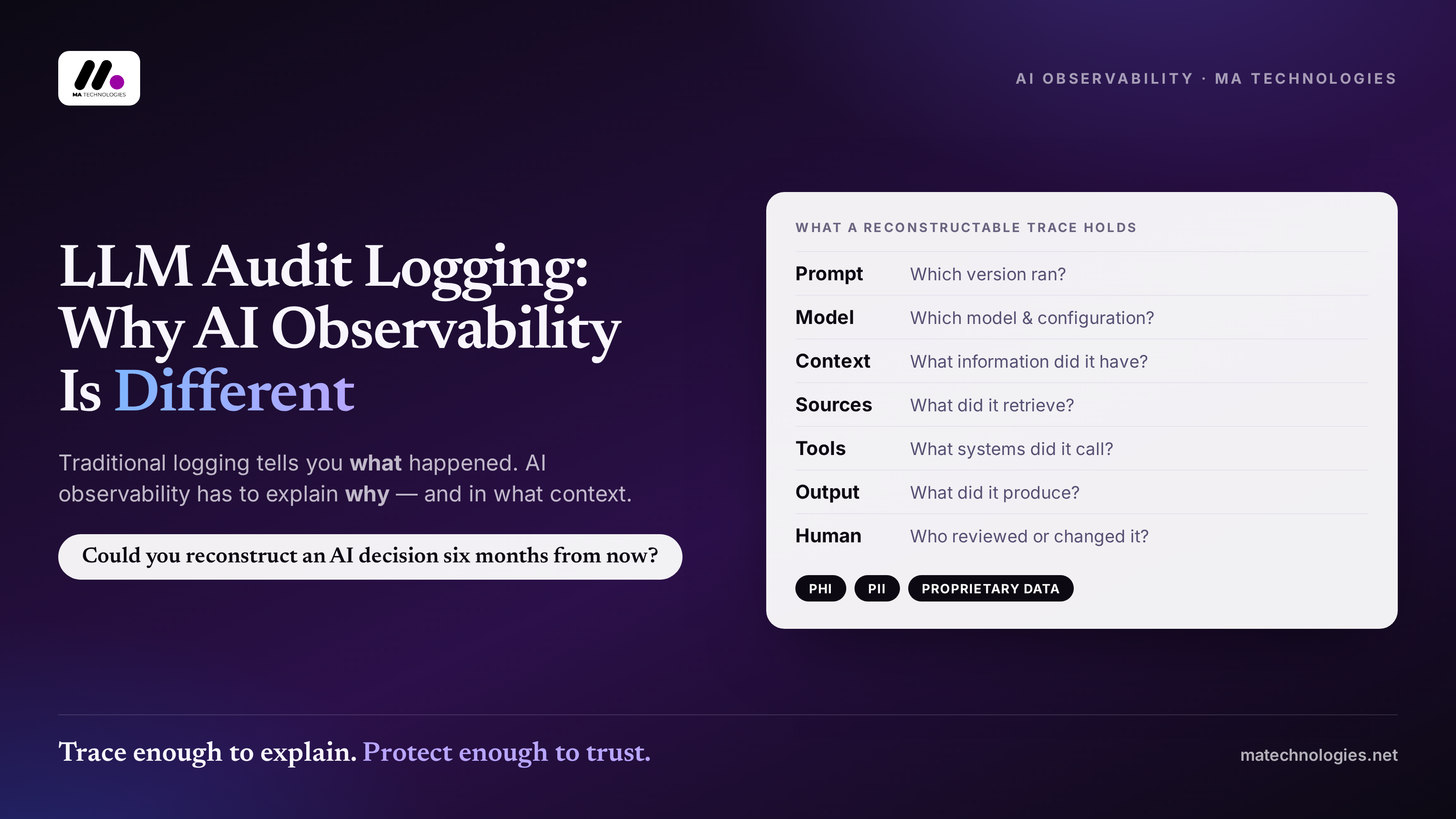
Traditional application logging was built around a fairly simple question: what happened?
An API received a request, a service processed it, a database was updated, and the application returned a response. If something broke, engineers could usually follow the trail backwards through logs and traces and work out where things went wrong. That works because conventional software is, for the most part, predictable. Give the system the same inputs and conditions, and you generally get the same behaviour.
LLM applications make that much harder.
Imagine an AI system tells someone, “This participant appears eligible for the study.” Three months later, somebody challenges that recommendation. Your application log says the request succeeded, the API returned 200, and the whole thing took 2.4 seconds. Technically, everything looks healthy. But can you actually explain the answer? What was the AI asked? Which prompt was running? Which model version? What protocol or documents did it retrieve? Was a recent amendment included? What patient information was available to it? Did it call another system before producing the answer?
The application can be working perfectly while the reasoning context behind the output has disappeared.
A prompt is rarely just a prompt
We often picture an AI request as Prompt → Model → Response. In production, it is usually closer to a small supply chain. A user’s question might be combined with a system prompt, previous conversation, retrieved documents, database records, business rules and tool outputs before the model ever sees it.
The model may then call another tool, receive new information, generate a response, pass that response through a guardrail and only then return something to the user.
So if the answer is questioned later, keeping the original user prompt doesn’t tell you very much. It’s like trying to understand why a person made a decision by recording only the question they were asked, but none of the information sitting on the desk in front of them.
What a real AI trace preserves
Prompt
The prompt as assembled, and the version it came from.
Model
Model, version and configuration in effect at that moment.
Context
Conversation, records and business rules that shaped the input.
Sources
Retrieved documents and the exact versions used.
Tools
Tool and API calls made, with what they returned.
Guardrails
Safety and policy decisions applied to the output.
Human
Who intervened, approved, edited or released the result.
The trace is the story
Flat logs become less useful as AI workflows become more sophisticated. A single request might trigger retrieval, several API calls, one or more LLM calls and a final safety check. You can log every one of those events and still end up with a pile of disconnected facts.
Tracing gives you the missing relationship. Instead of asking engineers to piece together what happened from dozens of log entries, you can follow one request from beginning to end and see how the pieces interacted.
If an engineer had to investigate one response six months from now, could they follow one trace and reconstruct the journey — or would they be searching through logs hoping to find the right pieces?