
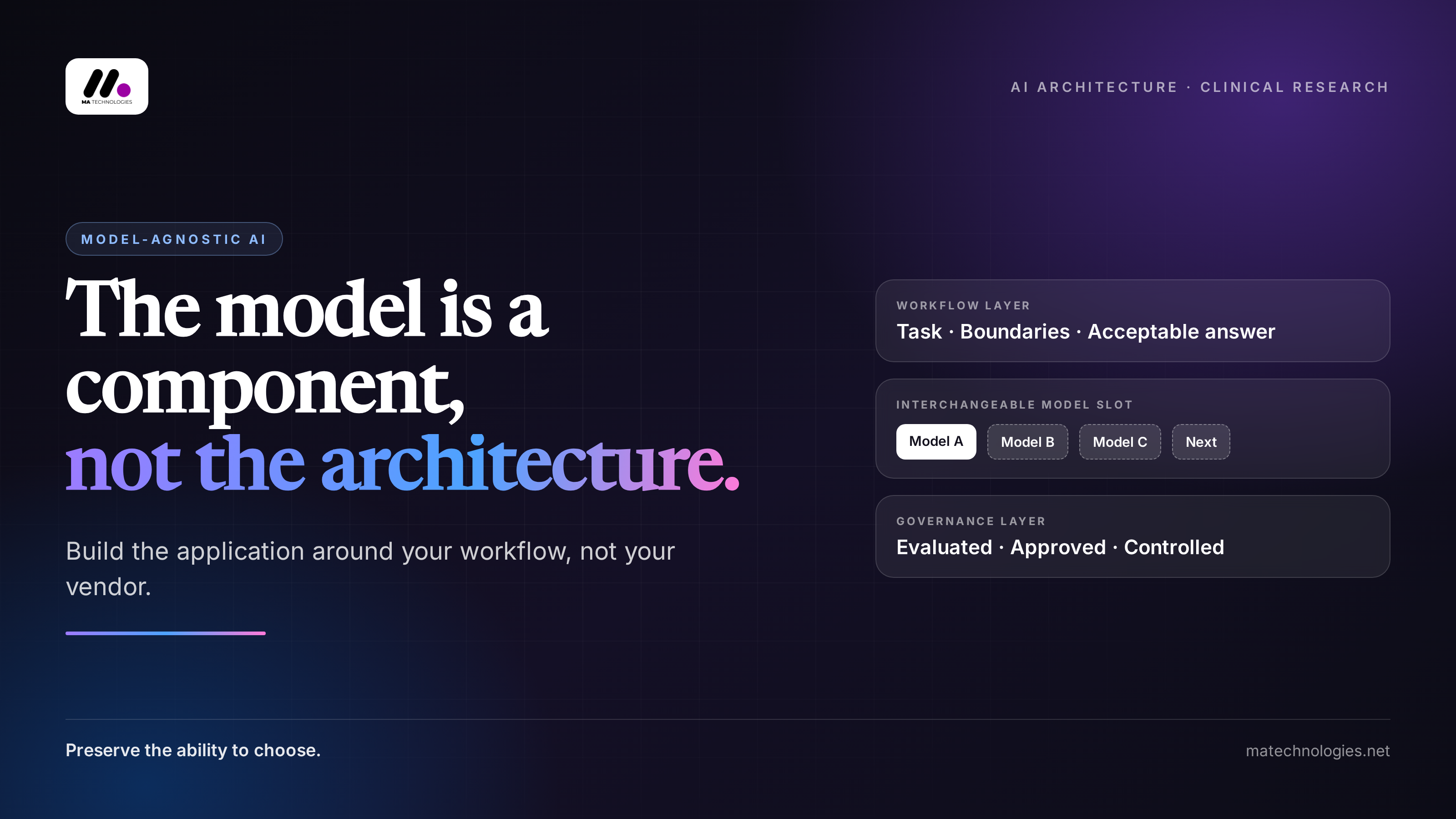
When we talk about being tied to a single LLM provider, the conversation usually starts with vendor risk. That makes sense, but I think it misses the bigger issue: being too dependent on one model can also make AI harder to scale.
As AI moves deeper into clinical research workflows, the model underneath an application starts affecting much more than the quality of its answers. It can affect cost, speed, capacity, availability, and how much work is involved when something changes.
And something will change. Pricing changes. Models improve. Older models get retired. New capabilities appear. (Anyone who has worked with enterprise technology for long enough has seen this before.)
So the question for clinical innovation and technology leaders isn't simply whether we can switch models. It's how much of the application we would actually have to change if we needed to.
That's really what model-agnostic architecture is about.
Cost
Pricing shifts change the economics of every high-volume task.
Capacity
Throughput and rate limits shape what the workflow can absorb.
Availability
Models get retired, deprecated or repositioned without your input.
Change cost
How much of the application has to be rewritten when any of it moves.
Think of the model as part of the system, not the system itself
One approach we often see is to connect an application to several AI providers and assume that creates flexibility. Technically, it helps. In practice, an application can still become heavily dependent on one provider because of how prompts are written, how outputs are structured, how tools are used, or how the model behaves.
Think about changing the engine in a car. It's one thing if the engine is a component designed to be replaced. It's another if the transmission, electronics, dashboard, and controls have all been designed specifically around that engine.
AI systems can end up in the same position.
The goal is to separate the business workflow from the particular model doing the work. A clinical research application, for example, might need to review a monitoring report and identify potential follow-up actions. That's the job. Whether one model or another performs it should ideally be a technology decision underneath the workflow.
We've found it useful to think about this in simple terms: the application should define what it needs, what an acceptable answer looks like, and what the AI is allowed to do. The model performs the task within those boundaries.
That last part matters. An AI system might search documents, retrieve study information, or suggest creating a task. But the model shouldn't have unlimited control simply because it can request an action. (There is a big difference between suggesting what should happen and holding the keys.)
The application defines the job, the boundaries and what a good answer looks like. The model is what happens to be performing it today.
Being able to switch models doesn't mean they're interchangeable
This is where the idea gets more interesting.
Different AI models don't behave in exactly the same way. A set of instructions that works beautifully with one model may produce a different result with another. Models can vary in how they interpret instructions, handle long documents, use tools, and produce consistent outputs.
So simply connecting to another model isn't enough. We also need to know whether that model can actually do the job.
Evaluate against the real workflow
- Representative documents from the real workflow
- Unusual and edge-case records
- Ambiguous or incomplete information
- Known failure scenarios
- Examples where a good result is already defined
I think this changes the question in a useful way. Instead of asking, “Which AI model is best?” we can ask, “Is this model good enough for this particular job?”
That's closer to how we make decisions elsewhere in a business. We don't assign the most senior, expensive expert to every routine task simply because they're capable of doing it. A straightforward, high-volume task may work well with a smaller or less expensive model. A complicated task may need something more capable.
(Headline AI benchmarks are interesting. Your actual workflow is what matters.)
Once an organization understands which models work for which jobs, model choice becomes something it can actively manage rather than a technology decision made once at the beginning of an AI initiative.